

The quest to use fusion power for break-even electricity generation has sometimes been described as “putting the sun in a jar”. Where by “jar,” we mean a carefully arranged series of coils that produce a powerful confining magnetic field. Usually it’s called a tokamak (toroidal design) or stellarator (complicated twisty design that is still topologically a toroid).
The sun is so enormous that confinement happens as a natural result of its own gravitational field. On the other hand, the relatively small amount of plasma in a fusion reactor on Earth needs to be squeezed from the outside. But other than the nature of the confining force, you might think that the fusion reactions in a reactor are basically the same, physics-wise, as the fusion reactions in the sun.
This is not true.
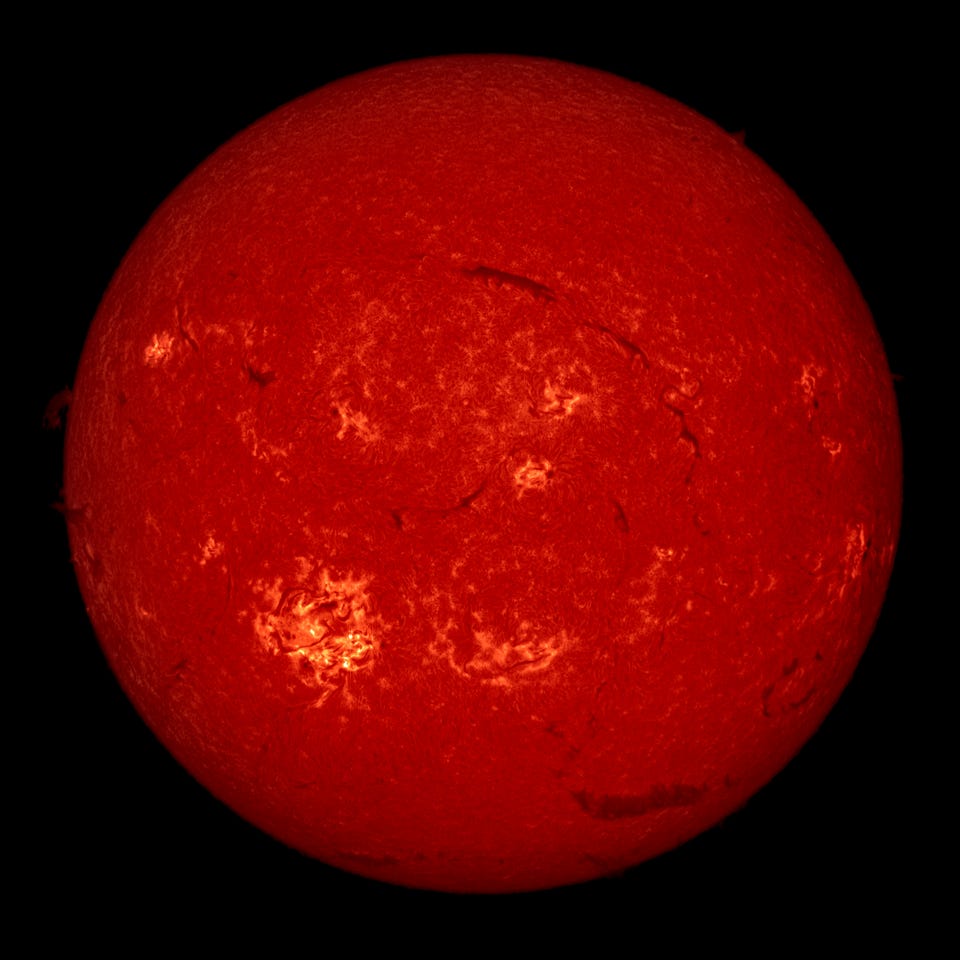
One hint that it’s not true comes from the following fact: The sun has an expected lifespan in the billions of years. From this we can infer that it does not burn its hydrogen fuel very quickly, taking a million years to burn even a tiny fraction of it. Which means that the power density of the sun is actually surprisingly low. At the very center of the sun’s core, where fusion reactions are happening the fastest, fusion reactions generate power with a density of 270 W/m³. This is roughly equivalent to the power density produced by a compost pile.1
The only reason the sun’s surface can reach a temperature of nearly 5800K is because the sun is extremely big and surface area scales slower than volume. Heat is produced in the core, a 3-dimensional volume, and escapes only through the 2-dimensional surface, so the surface has to get very hot to radiate away heat at the same rate as it is generated.
Of course, it would not make sense if fusion projects were getting millions of dollars of investment to build compost piles out of plasma. They must be able to get a much higher power-density out of their reactors somehow.
Temperatures and Pressures
So is the difference that man-made reactors are operating at a higher pressure or perhaps temperature?
Well, it’s certainly not a higher pressure. The sun is so massive that everything else in the solar system orbits around it. Its surface gravity is 28 times stronger than Earth’s. The center of the sun is underneath all that mass, resulting in a whopping 2.35×10¹⁶ Pa of pressure. This is a pressure we humans can’t come close to matching by setting up some puny magnetic fields.
What kinds of pressures can we reach? This is not a commonly published figure. However, electron density is often recorded and published. At the center of the ring of plasma in the JT-60U reactor in Japan, the density of electrons can reach 3×10¹⁹m⁻³. The temperatures of the electrons and ions can differ and are about 10keV and 20keV respectively.2 We can assume that the density of ions (bare nuclei) is roughly the same.
Then we can misapply (fusion plasmas are very much not an ideal gas) the ideal gas law to get a Fermi estimate of the pressure this reactor reached.
The ideal gas law is
where P is pressure, n is particle density, k is Boltzmann’s constant, and T is temperature. In this situation, we’re adding the pressures contributed from two kinds of particle (ions and electrons). So we compute:
Or, in more familiar units:
Yes, all these amazingly strong superconducting magnets are only able to pressurize the plasma to roughly an atmosphere.
Keeping in mind that this is a very rough estimate, it’s clear that Tokamaks are not going to win on the pressure side of things, and in fact have a huge disadvantage there.
As for temperature: The sun’s core has a temperature of about 1.57×10⁷ K. Which equals 1.4keV. Comparing this with the 20keV ion temperature, the JT-60U reactor reached a temperature about 15 times higher than the core of the sun in that experiment.
So if the reactor is 15 times hotter, does that explain the difference in power density? It’s possible for reaction rates to scale exponentially with temperature, so it’s certainly not out of the question.
The answer turns out to be no, though. This diagram3 shows reaction rates for deuterium-tritium fusion at various temperatures:
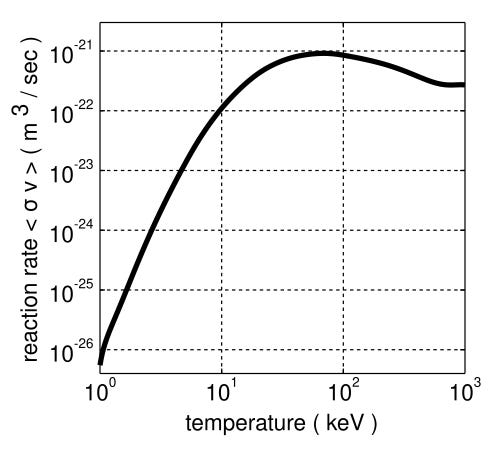
At solar-core temperatures, we get a reaction rate of about 10⁻²⁶ m³/s. At fusion reactor temperatures, we get a reaction rate of about 10⁻²² m³/s. This is 10000 times faster, but that doesn’t even compensate for the density difference caused by the far lower pressure of the fusion reactor.
But as you may have noticed, this is simply the wrong chart to be using to determine the sun’s rate of fusion, because the sun does not fuse deuterium to tritium.
Reaction Type
The most common isotope in the universe is Hydrogen-1, the simple proton. Protons make up most of the sun’s mass, and also most of its fusible fuel. So it is not too surprising that the main reaction powering the sun is one that burns protons. It is called the proton-proton chain, and one of its key features is that is not a single step process like deuterium-tritium fusion is. Instead, it consists of multiple reactions all feeding into each other:
Two protons fuse together and one of them changes into a neutron, forming deuterium. This is the rate limiting reaction in the chain. It is slow because changing a proton into a neutron requires the weak nuclear force, which is not as strong as the strong nuclear force [citation needed]. (The other thing going on here is that protons on their own are more stable than neutrons: a free neutron will turn into a proton on a timescale of roughly 15 minutes. So these protons are only motivated to change into a neutron during the few times when they’re very briefly smushed against another proton due to a lucky collision in the sun’s core.)
One more proton fuses with deuterium to form helium-3.
Then there are several different options for how the final end product of helium-4 is produced. The most dominant one in the sun is as follows:
Two helium-3 nuclei fuse into a beryllium-6 nuclei. Because 4 protons is far too many for such a small nucleus, it immediately spits out two of them, leaving helium-4.
Anyway, because of that slow first step, this reaction does not happen quickly at all. If we tried to make a fusion reactor powered by the proton-proton chain, it would be about as useful as an oversized plasma globe. This is why most fusion projects decide to use deuterium-tritium fuel. Reach a high enough plasma temperature (see above chart), and deuterium (hydrogen-2) and tritium (hydrogen-3) will react with each other, producing a helium-4 nucleus, a neutron, and 17.6 MeV of energy. Overall, we are lucky that physics permits such a nice reaction, though it does have a few inconvenient aspects.
Firstly, most of the energy produced is carried by the neutron. Because neutrons, though they have a small but non-zero magnetic moment, mostly do not interact electromagnetically, this makes it difficult to collect the energy carried by the neutron. You basically have to put up a layer of some shielding material like lead. Neutrons colliding with nuclei in your shield heat it up, and then you need to use that heat to generate electricity.
Secondly, there’s a bit of a fuel scarcity issue: While deuterium is only about 0.01% of naturally occurring hydrogen, which makes it a bit of a pain to gather and separate from hydrogen-1, tritium is unstable with a half-life of 12 years and cannot be obtained from the environment at all. The solution to this problem is typically to have the fusion reactor make its own tritium. A common idea is that the shield should be made from a liquid mixture of lead and lithium, where neutrons hitting the lithium can cause it to react and turn into tritium and helium, regenerating the tritium needed for the reaction to continue.
Thanks to the fact that Deuterium-Tritium fusion is basically one of the easiest possible fusion reaction to achieve, fusion reactors don’t need to match the extreme pressures inside of the sun in order to achieve fusion power densities many many orders of magnitudes higher than those in the very core of our star.
Artificial Fusion is Mostly Irrelevant for Electricity Generation
Unfortunately, while it seems decently likely that fusion can eventually be made to work as a break-even power source, it will still be economically irrelevant. A fusion reactor would have a high capital cost, long construction times, and be subject to many of the same nuclear regulations that a fission plant would be. The deuterium fuel and the lithium used for tritium-breeding require isotope separation, which adds further cost. Both a fusion plant and a fire-based power plant need a boiler and turbine4 and generator, it’s just that the fusion plant’s heat source is a marvel of nuclear and magnetohydrodynamic engineering and has superconductors in it, while the fire-based plant’s heat source is burning stuff.
So why care about fusion power at all? Well, fusion does have a few advantages. The fuel is fairly abundant, and you don’t need to find a large sunny area to site your power plant like you do with solar panels. While fusion won’t be economical in any world that looks even slightly normal to us, things might be different as technology develops far beyond current levels. Suppose that an AI has taken over and is now running the world. For the AI, engineering effort is nearly costless, and the prices of things approach the cost of their raw materials (plus invested energy costs of course), no matter how technologically complicated they are. For that AI, fusion power could look quite attractive. While the power density of solar panels is limited by surface area, fusion power density is mostly limited by your ability do disperse all the waste heat you’ll generate.
And who knows, maybe one day we’ll figure out how to break-even with muon catalyzed fusion somehow.
See: en.wikipedia.org/wiki/Sun
And a relevant xkcd: what-if.xkcd.com/148/
You can compute the 270W/m³ number yourself by looking at the luminosity column here.
Image credits for this post:
https://commons.wikimedia.org/wiki/File:BBSO_full-disk_H-alpha_2002-07-26_153931_color.png
https://commons.wikimedia.org/wiki/File:DT_fusion_rxnrate.svg
An interesting question is whether fusion power would be practical to power an industrial explosion, assuming we somehow get AIs good enough such that robotics and compute growth becomes a real area of investment in the 2030s and 2040s, but aren't so good that they instantly take over?
See the scenario Twenty Years from RSI to Takeoff: Slow Learning, Scaling Slowdown, Industrial Explosion for an example of this sort of scenario below:
https://www.lesswrong.com/posts/LP6uCXs6Ea5qSbWpY/twenty-years-from-rsi-to-takeoff-slow-learning-scaling